
One of the most common questions once a company takes the transparency of AI-generated content seriously is surprisingly mundane: "okay, so how do I flag it? Do I add text? A symbol? Which one?" Until recently, everyone improvised their own solution. Now there's an official answer: the European Commission has published a set of AI content labelling icons, downloadable, free and free to use. It's a small piece, but it solves a real problem. This is the guide to using it well.
The figure allocates the four duties of Article 50: the notice that people are interacting with an AI system and the marking of synthetic content fall to the provider; the information on emotion recognition or biometric categorisation and the disclosure of deep fakes and of text published to inform the public on matters of public interest, to the deployer.
What the set contains
The official resource includes three icons, designed for three different situations:
- An icon for content that is entirely AI-generated — the image, video or audio that came entirely from a model.
- An icon for content partially modified by AI — the real photograph retouched with generative tools, the video with synthetic elements added.
- A basic icon for general AI signalling.
Each comes in several visual variants, in SVG and PNG formats, under a free-use licence and with no attribution requirement. The packages are downloaded directly from the Commission's official pages. There's no need to ask permission, register or pay anything.
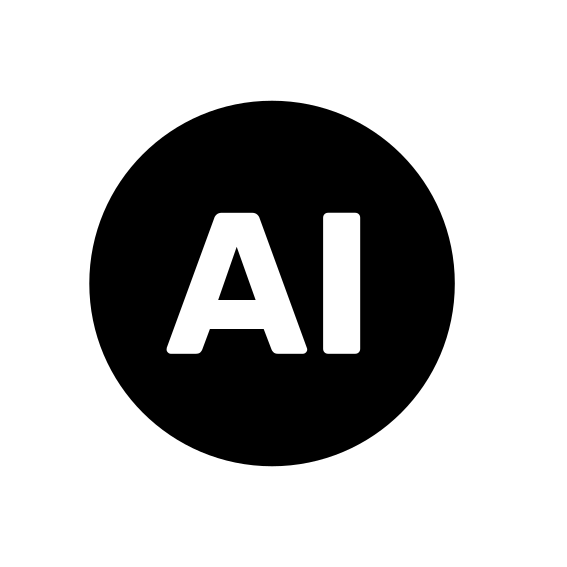
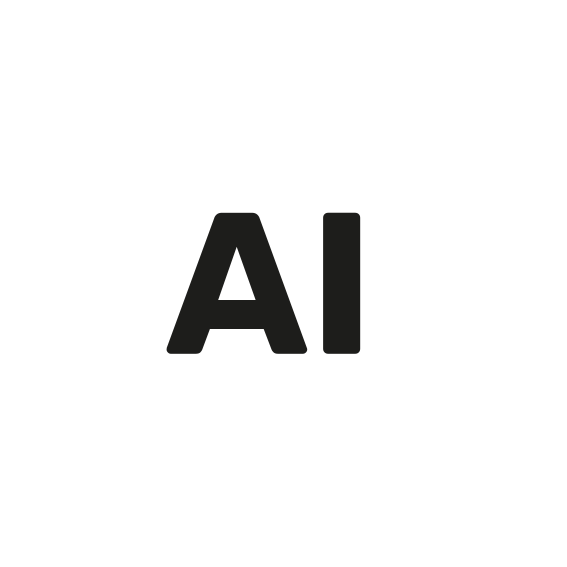
Basic icon
When AI was involved in creating a deepfake or a published text, or when a custom text label or an interactive second layer accompanies it.


Fully AI-generated
When the deepfake or the text is generated entirely by AI.

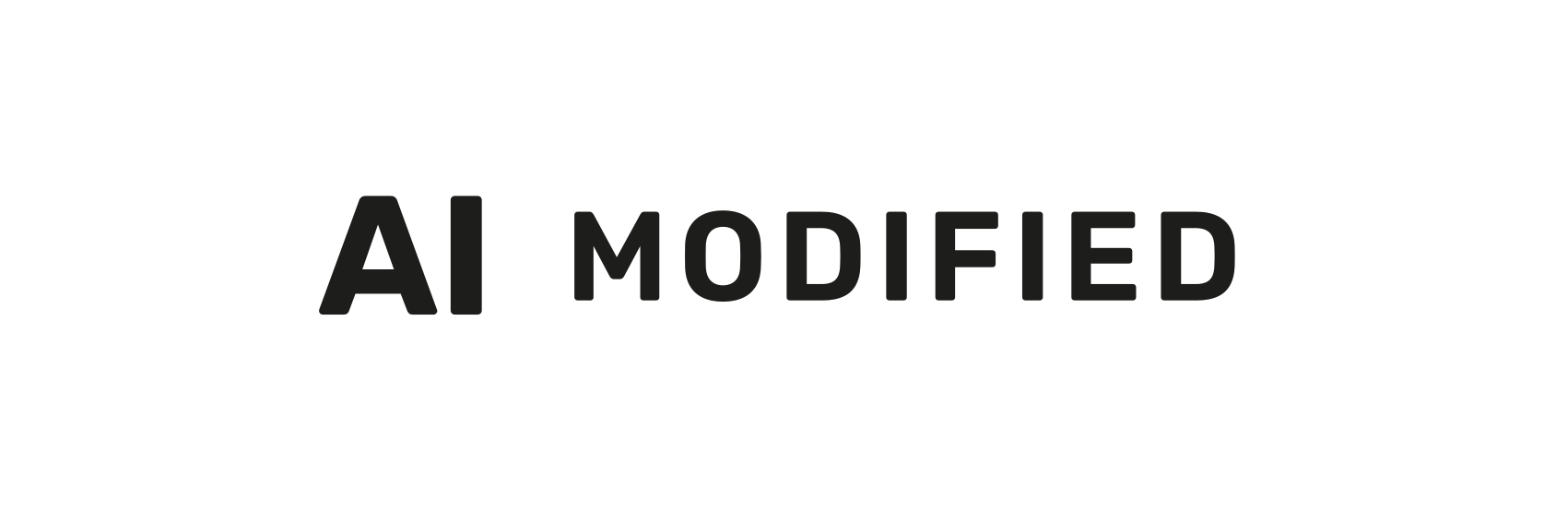
AI-modified
When AI modified content that already existed.
The figure shows the three official icons exactly as the Commission publishes them: the basic one, with the letters “AI”; the fully AI-generated one, with “AI GENERATED”; and the AI-modified one, with “AI MODIFIED”. All three in black on a light background and in white on a dark one, which are two of the set’s four variants. Under each, when the Commission itself uses it. And in the caption, the two limits it sets: the icon does not establish compliance by itself, and using it without having signed the Code of Practice does not mean having adhered to it.
When it makes sense to use them
The icons operationalise one specific Article 50 obligation: the one in paragraph 4, which belongs to the deployer — disclosing that a deepfake has been artificially generated or manipulated. They don't replace the marking under paragraph 2, which is a different thing: a technical obligation on the system's provider, in a machine-readable format and embedded in the content itself. For an SME, the typical scenarios:
Marketing with generated images or video. Campaign creative made with generative tools, especially when it depicts realistic scenes that could be mistaken for authentic. This is the central case of deepfake labelling, and the "entirely generated" icon is its natural signal. Where the piece forms part of an evidently artistic, creative, satirical or fictional work, the duty is limited to disclosing the existence of the content in a way that does not spoil the work.
Corporate material with generative retouching. The product photo extended with generative fill, the corporate video with a synthetic voice. Territory of the "partially modified" icon.
Interfaces and publications where you already give notice in text. The icon doesn't replace the notice when text is what's required, but it reinforces it with a recognisable visual signal — and, over time, a recognised one, which is the value of a common standard.
Placement matters as much as the choice: the icon must be visible at first contact with the content, not hidden three clicks away on a legal page. A corner of the image, the start of the video, the immediate caption of the piece. The common-sense rule: if a reasonable person can consume the content without seeing the signal, the signal isn't doing its job.
The two nuances that keep you from using them wrong
And here are the two warnings that separate correct use from self-deception, as the Commission itself frames them:
First: the icon is optional; the Article 50 requirements are not. Nobody is required to use these specific icons — they're a tool on offer, not one imposed. You can meet the transparency requirement through other suitable means. What you can't do is not meet it: the obligation for the content to be identifiable exists whether there's an icon or not.
Second: the icon, on its own, does not establish compliance. Slapping a symbol on an image doesn't fix an uncontrolled content pipeline. The icon is the visible signal of work that has to exist underneath: knowing what content you generate, deciding what requires labelling and what doesn't, and being able to demonstrate that reasoning. The signal without the work is decoration.
That underlying work connects with this week's other two pieces: the Transparency Code the Commission has just given the green light, which provides the framework of measures these icons fit into, and — for the specific case of text — the editorial-review route.
In practice: a minimal workflow
For an SME publishing AI-assisted content, the full circuit fits into four steps: identify which pieces carry generated or modified content; decide, on a written basis, which ones require labelling; label with the official icons (or the equivalent means you choose) in a visible position; and record the decision — which piece, which label, who decided it. That last step is the one almost everyone skips, and the only one that covers you when someone asks. As with almost everything in this field: the label is the visible part; the evidence is the part that counts.
Article 50 series → the four paragraphs on one page.
This article is for informational purposes only and does not constitute legal advice.