
Step 3
Classify the risk of each use, with the rationale in writing
By the end of this step you will have a classification record: each system with its level, the rationale behind it, the date and who decided it.
What this step is
Classifying means placing each system in the inventory where the Regulation puts it, and writing down why. You classify the use, not the product: the same language model can draft sales emails or filter job applications, and those are two different classifications.
The Regulation does not rank systems on a single scale. It has prohibited practices (Article 5), high-risk systems (Article 6 and Annexes I and III) and transparency obligations (Article 50), which are not a risk level but obligations triggered by the nature of the system. The remaining AI systems carry no obligations specific to their risk level, although they remain subject to those that apply to every system, such as the Article 4 AI literacy measures.
To organise that map, Alethexis uses a seven-level scale, from P0 (out of scope) to P6 (prohibited practice). It is Alethexis’s internal taxonomy, not the AI Act’s nomenclature: it organises the work, and when a level derives from an article of the Regulation, the rationale cites it.
Why
The order runs from most to least serious. First, the prohibited practices of Article 5, applying since 2 February 2025: among them, subliminal or purposefully manipulative or deceptive techniques causing significant harm, social scoring leading to detrimental treatment, and inferring emotions in the workplace and in education institutions, except for medical or safety reasons. Regulation (EU) 2026/1744 adds two more, on non-consensual intimate content and child sexual abuse material, applying from 2 December 2026. A use that fits here is placed at P6 and stopped.
Next, high risk, which comes by two routes. One is Article 6(1): the system is a safety component of a product covered by the legislation listed in Annex I, or is itself such a product, and that product must undergo a third-party conformity assessment. The other is Annex III: uses in biometrics, critical infrastructure, education, employment and workers’ management, or the evaluation of natural persons’ creditworthiness, among others. The obligations in Sections 1 to 3 of Chapter III —Article 26 among them— apply from 2 December 2027 for Annex III high-risk systems and from 2 August 2028 for Annex I systems; they do not reach products under Section B of Annex I. An Annex III system may not be considered high-risk if it does not pose a significant risk —for instance, because it performs a narrow procedural task—, unless it profiles natural persons; that assessment is documented by the provider before placing it on the market (Article 6(3) and (4)).
Finally, the transparency obligations of Article 50, applying from 2 August 2026 (for the marking under paragraph 2, Article 111(4) sets 2 December 2026 as the deadline for systems placed on the market before that date), and this is where the role from step 2 returns. Paragraphs 1 and 2 bind the provider: designing the system so that people know they are interacting with an AI, and marking synthetic content. Paragraphs 3 and 4 bind the deployer: informing people exposed to an emotion recognition or biometric categorisation system, and disclosing that a deep fake has been artificially generated or manipulated, among other cases. If you deploy a third party’s chatbot, the paragraph 1 notice is the provider’s obligation; checking that it is there is verification diligence on your side, an internal methodological control.
The Alethexis scale carries that order across: P6 for what is prohibited, P5 for high risk, P3 for transparency and P0 for what falls outside the scope. Levels P1, P2 and P4 are Alethexis’s own rules, an internal methodological control. And a trigger that is an internal control does not raise the level: only an obligation that binds what your organisation is in relation to that system does.
How, in three actions
Walk through the order, system by system
For each row of the inventory, answer in this order: does it fit a prohibited practice in Article 5? Is it a safety component of a regulated product, or is its use listed in Annex III? Does it trigger an Article 50 obligation that binds your role in that system? The first level that applies is the result; do not keep going down in search of a more comfortable one.
Write the rationale, not just the label
Next to the level, note in two or three lines which questions you answered and with what fact: “use: prioritising job applications for interview; Annex III, point 4(a)”. If the case is unclear, record it as unclear, with what is still unknown and whom you have asked. If the provider maintains that its Annex III system is not high-risk, ask for the assessment it documented and file it with the classification.
Date, author and what reopens it
Each classification carries the date, who decided it and the version of the inventory it was based on. Decide what reopens it: a change of use, a new feature of the system, a change of role. A classification does not expire, but it goes into review when something relevant changes, and the new version does not erase the old one: both remain, each with its date.
The typical mistake
Classifying the tool instead of the use.
“We use a generative AI assistant, minimal risk” is a sentence you often read, and it classifies nothing. The same assistant drafting a newsletter and scoring job applicants are two uses with different outcomes: the second falls within Annex III. The variant of the same mistake is picking the lowest level when in doubt. You avoid it by describing the specific use in the inventory and letting the Regulation’s order, from most to least serious, decide rather than intuition.
Estimated time
Two or three days, between days 10 and 15 of the Route: most systems are settled in minutes, and the time goes on the two or three unclear cases.
What you take away
The classification record: each system with its level, the written rationale, the date and the author of the decision.
How it works in Alethexis
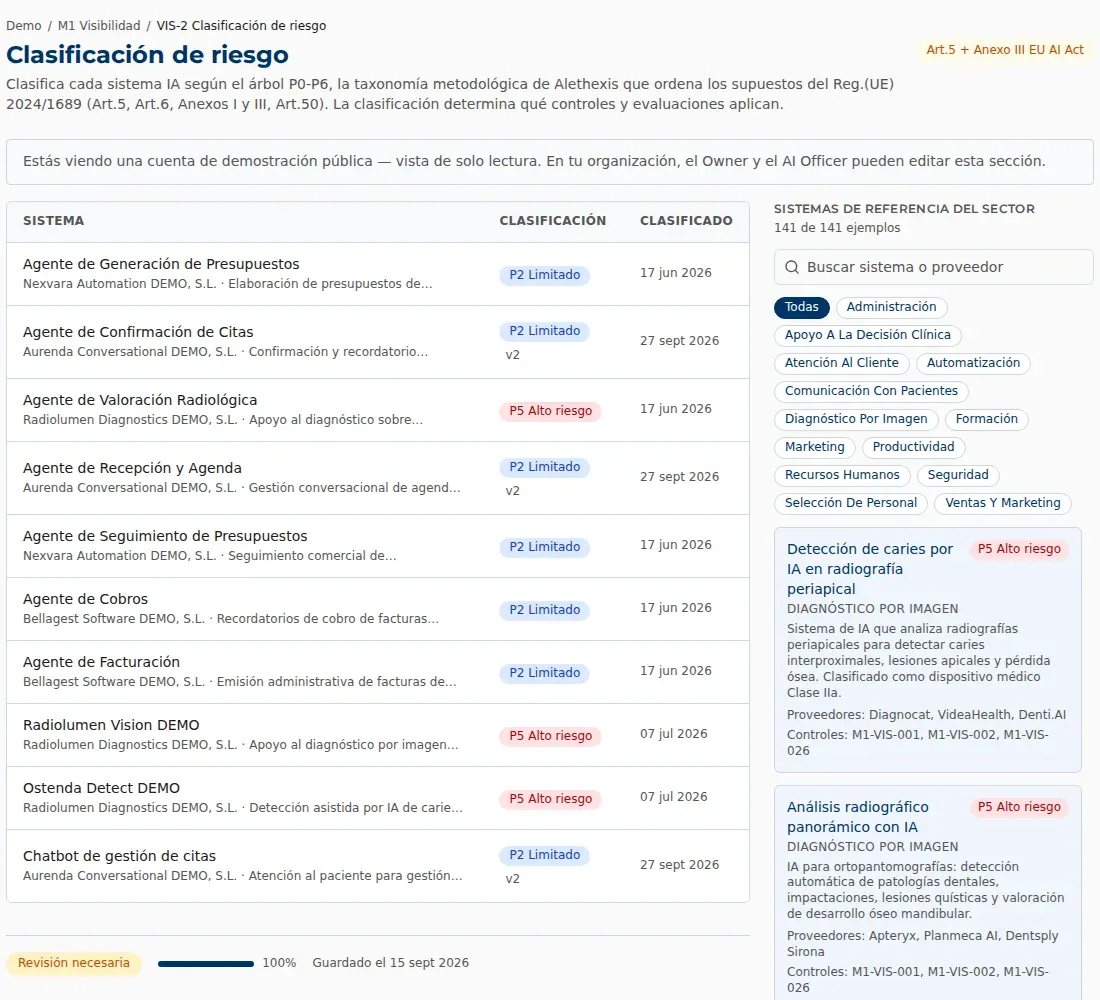
In Alethexis, an assistant goes through six steps per system —use, prohibited practices, data, context, autonomy, and transparency and general-purpose models— and the validator then applies the order from most to least serious; if your answers suggest one level but a rule of the Regulation redirects it, the assistant explains why and the validator’s result prevails.
The rationale is built from your answers and can be edited before closing; on confirming, a new version is saved and the previous one is archived, and on closing the section the declaration is recorded with name, role, date and the hash of the content.